Evaluating 3D Snow Scenes for Professional Cardmaking Workflows
In the competitive landscape of handmade stationery and small-scale publishing, efficiency often dictates creative choices. For professionals managing holiday product lines or educators organizing seasonal workshops, the balance between aesthetic complexity and production speed is critical. The 3D Snow Scenes collection addresses this specific operational bottleneck by providing a structured, high-resolution digital asset system designed for the 6 x 6 Mini Kit format. Unlike generic clip art packs, this resource functions as a comprehensive manufacturing template, integrating structural components with decorative elements to streamline the assembly process without sacrificing visual depth.
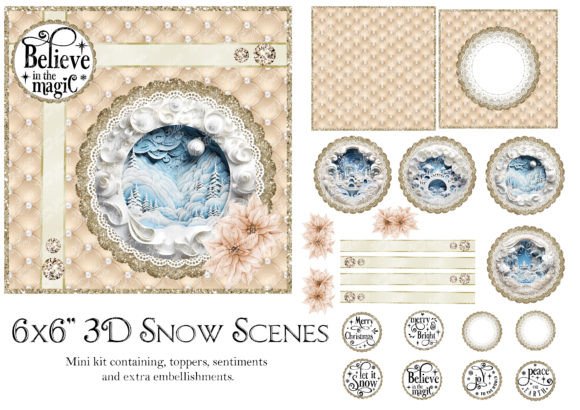
The primary value proposition of 3D Snow Scenes lies in its architectural approach to paper crafting. Rather than offering isolated images, the kit provides a cohesive ecosystem of printable assets. This includes four distinct pages containing a pre-sized card base, a matching interior insert, six unique toppers, coordinated sentiments, and modular embellishments. For freelancers and creators evaluating digital assets, this level of integration reduces the cognitive load associated with design matching. The assets are engineered to interact spatially, ensuring that when layers are stacked, the alignment and scale remain consistent across multiple units. This predictability is essential for batch production where variance can lead to material waste and increased labor costs.
Technical Specifications and Print Reliability
Digital assets for physical fabrication must meet rigorous technical standards to be viable in a professional setting. 3D Snow Scenes is rendered at 300 dpi, which serves as the industry benchmark for crisp, artifact-free printing on cardstock. In practical testing, this resolution maintains edge definition even when printed on textured linen or matte cover stocks. Lower resolution files often exhibit pixelation or color banding when scaled or layered physically; however, these files retain integrity during the cutting and scoring phases. For publishers or bloggers creating tutorial content, this fidelity ensures that photographed results accurately represent the digital source file, maintaining credibility with an audience that values precision.
The color management within the snow scenes warrants specific attention. White-on-white layering is notoriously difficult to execute effectively because it relies entirely on shadow and texture rather than hue contrast. These digital designs utilize subtle grayscale gradients and simulated lighting effects to create perceived depth before any physical foam tape is applied. This means the base print carries significant visual weight independently. If a creator chooses to forgo the full 3D assembly due to time constraints, the printed topper still functions as a complete, professional-grade flat image. This redundancy adds a layer of risk mitigation to the workflow, allowing for flexibility in fulfillment strategies.
Versatility Across Formats and Scales
While the nomenclature specifies a 6 x 6 Mini Kit, the utility of 3D Snow Scenes extends well beyond this footprint. The design architecture supports scaling for larger formats, such as A2 or 5 x 7 cards, through strategic matting and layering. Professionals should view the 6 x 6 topper not as a fixed boundary but as a central focal point. When placed on a larger card base, the negative space around the topper becomes an active design element. The included extra embellishments facilitate this transition, allowing creators to build outward from the center without losing compositional balance.
- Standard Application: Direct adherence to the 6 x 6 card base for quick-turnaround gift tags, place cards, or mini notes.
- Expanded Application: Centering the topper on an 8 x 8 or A2 base with a contrasting mat to elevate the perceived value and presence of the piece.
- Modular Adaptation: Separating the sentiment from the image to create custom layouts where typography needs to be repositioned for different aspect ratios.
This scalability is particularly relevant for marketers and small business owners who need to maintain brand consistency across various collateral sizes. Using the same core 3D Snow Scenes assets for both a product package insert and a direct mail postcard creates a unified visual identity while minimizing design hours. The extra embellishments serve as connective tissue between these formats, providing filler elements that adapt to whatever whitespace the new configuration demands.
Workflow Integration and Production Value
For serious hobbyists and educators, the inclusion of a matching insert and card base transforms this from a simple image pack into a lesson plan or project kit. In workshop environments, having pre-coordinated bases eliminates the "blank page" paralysis that often consumes valuable instruction time. Participants can focus immediately on technique—specifically foam placement, shading, and precision cutting—rather than color theory or layout planning. The six different toppers provide enough variation to prevent repetitive strain or boredom in group settings while remaining thematically identical enough to simplify supply management.
From a commercial perspective, the sample card image offers dual functionality. It serves as a reference guide for assembly, but it is also formatted to be printed and used as a standalone card. This feature is significant for vendors selling physical kits or digital downloads. The sample acts as both marketing material and inventory. If a customer prefers a flat card over a 3D construction, or if the seller runs out of foam adhesives, the sample image remains a sellable SKU. This maximizes the return on investment for the digital file and reduces dead stock potential.
Assessing Limitations and Practical Considerations
Despite its strengths, 3D Snow Scenes requires specific resources to achieve the intended result. The 3D effect is dependent on physical spacing materials like foam tape or silicone glue. Users without access to these adhesives will only realize a fraction of the design’s potential. Furthermore, while the 300 dpi resolution is excellent, the final output quality remains tethered to the user’s printer capabilities. Inkjet printers may produce richer saturation for these winter scenes compared to laser printers, which can sometimes struggle with smooth gradient transitions in cool tones. Professionals must validate their specific hardware against the file characteristics before committing to large production runs.
Additionally, the intricate nature of snow scene layering demands a certain level of manual dexterity and patience. While the digital files are precise, the physical extraction of small, detailed paper elements can be challenging for those with motor impairments or limited experience with fine detail work. Educators using this kit should assess their students' skill levels and potentially prepare pre-cut elements or simplified assembly variations. The kit is optimized for efficiency, but it does not eliminate the inherent time cost of hand-assembled dimensional art. Realistic project timelines should account for 15–20 minutes per completed 3D card once proficiency is established.
Strategic Fit for Creative Professionals
Ultimately, 3D Snow Scenes is best evaluated as a specialized tool rather than a general-purpose asset. It delivers exceptional value for users who require dimensional winter aesthetics with reduced design friction. Freelancers fulfilling seasonal commissions will appreciate the standardized sizing and interchangeable sentiments that allow for rapid customization. Publishers creating holiday special editions benefit from the high-resolution reliability and scalable composition. Small business owners gain a versatile branding element that bridges packaging and greeting needs.
However, for creators seeking editable vector graphics or fully customizable illustrations, this raster-based kit may feel restrictive. The designs are finalized compositions, not modular building blocks for creating entirely new scenes from scratch. Understanding this distinction is key to satisfaction. When utilized within its intended parameters—as a high-fidelity, print-ready system for dimensional cardmaking—3D Snow Scenes offers a robust solution that harmonizes artistic tradition with modern production requirements. It represents a pragmatic intersection of creativity and commerce, enabling professionals to deliver complex, tactile experiences in a digital-first workflow.